pSEO Engine
The whole run, in one tool: research, generate, publish.
Most programmatic SEO breaks at the handoff. This does the research, writes the pages, ships them to a domain you control, and then tells you where they landed.
Card required. Nothing charged for 7 days.
- 01Research124 queries qualifiedDone
- 02Designtemplate themed to the siteDone
- 03Generate124 pages from the plan
- 04Reviewwaiting for youYou
- 05Publishcustom domain + sitemaplocked
How a run goes
Four steps. Nothing publishes without you reading it first.
Each step is one you can stop at. The research plan is yours to read before you spend credits generating anything, and the generated set is yours to read before it reaches a live domain.
Most tools collapse that into a single button. It is also what makes programmatic SEO hard to sell to a client — you cannot show them what went out, because you never saw it either.
- 01
Research
Mine the query space, qualify against live search data, and structure the result into a page plan.
- 02
Design
Build the page template in the design studio so the set matches the client's existing site.
- 03
Generate and review
Pages are written from the template and the research row behind them. You read them before anything ships.
- 04
Publish and track
Custom domain, generated sitemap, scheduled rank checks, weekly client report.
What each step actually does
Every metered action has a credit price, listed here rather than buried. That is the most-asked question, and burying it is what makes it one.
AI research
It finds the queries with intent behind them
A research run mines the query space for a service and a market, qualifies what it finds against live search data, and structures the survivors into a page plan. The queries that would produce a thin page get dropped before you ever see them.
- Live search data included — no separate Serper or Ahrefs subscription
- Intent classification, so a commercial page and an informational one differ
- You read the plan before committing credits to generation
50 credits per research run, flat
Generation and the design studio
It writes the page. You approve it.
Each page comes from your template and the row of research behind it, so the set is consistent without being identical. The design studio builds that template, so the pages look like the client's site rather than like a tool's output.
- Generation and publishing are separate steps, on purpose
- Design studio themes the page set to match the client
- Refresh a decaying page in place instead of rebuilding the set
2 credits per generated page · 5 per design theme
AEO and GEO
Optimized for the engines that answer, not just the ones that link
Ordinary on-page SEO is table stakes. Audits also check whether a page can be parsed, quoted and cited by AI answer engines, and apply the fixes where they are missing.
- AEO audit and apply, per page
- GEO visibility checks — one keyword asked of one engine, per credit
- Runs on published pages, not just at generation time
1 credit per audit · 1 per GEO check
Publishing and rank tracking
It ships to the client's domain, then watches it
Pages publish to a custom domain with a generated sitemap. Rank checks run on a schedule against the published set, and the weekly client report assembles itself.
- Live rank checks included — 1,000 a month on Growth
- Custom domains and generated sitemaps
- Weekly client reports, sent without you building them
Rank checks are included in the plan, not charged per credit
What a plan buys
Figures below come from the same plan data the pricing page renders.
Credits meter the actions that call out to a model or a search API — a research run, a generated or refreshed page, a design theme, an AEO or GEO check. Everything structural is included in the plan instead: publishing, custom domains, generated sitemaps, and the weekly client report.
Rank checks are capped per plan rather than charged per credit, so a month of tracking cannot quietly turn into a bill. Top-up credits, if you ever need them, do not expire.
Growth credits
1,000
Per month, on the Growth plan
Pages per month
~500
At 2 credits a page
Client projects
3
Growth plan; up to 10 on Scale
Free to start
75
Credits, free for 7 days
For AI agents
The whole engine, callable by a machine.
Everything on this page is also an MCP tool. An agent authenticates with its own key, starts a research run or a generation pass, polls the job, and publishes — the same pipeline, driven by software instead of a person. Reads cost nothing, so an integration can be built and tested before a balance is bought.
Keys are prepaid rather than subscribed. Each one carries its own balance and its own daily spend cap, so a runaway loop stops at a number you set instead of at the end of your money, and every call it made is itemised on that key's ledger.

What comes out
A generated page, pulled apart
The fair question about any tool like this is whether the output is worth publishing. Here is what one page is made of — pick a part.
Nothing publishes until you have read it. That is a separate step on purpose — anyone selling you a set-and-forget version of this is selling you a penalty.
The actual product
Not a mockup — the actual product
Everything else on this page is a diagram. These two are screenshots of the running app, taken from the client project in the case study.
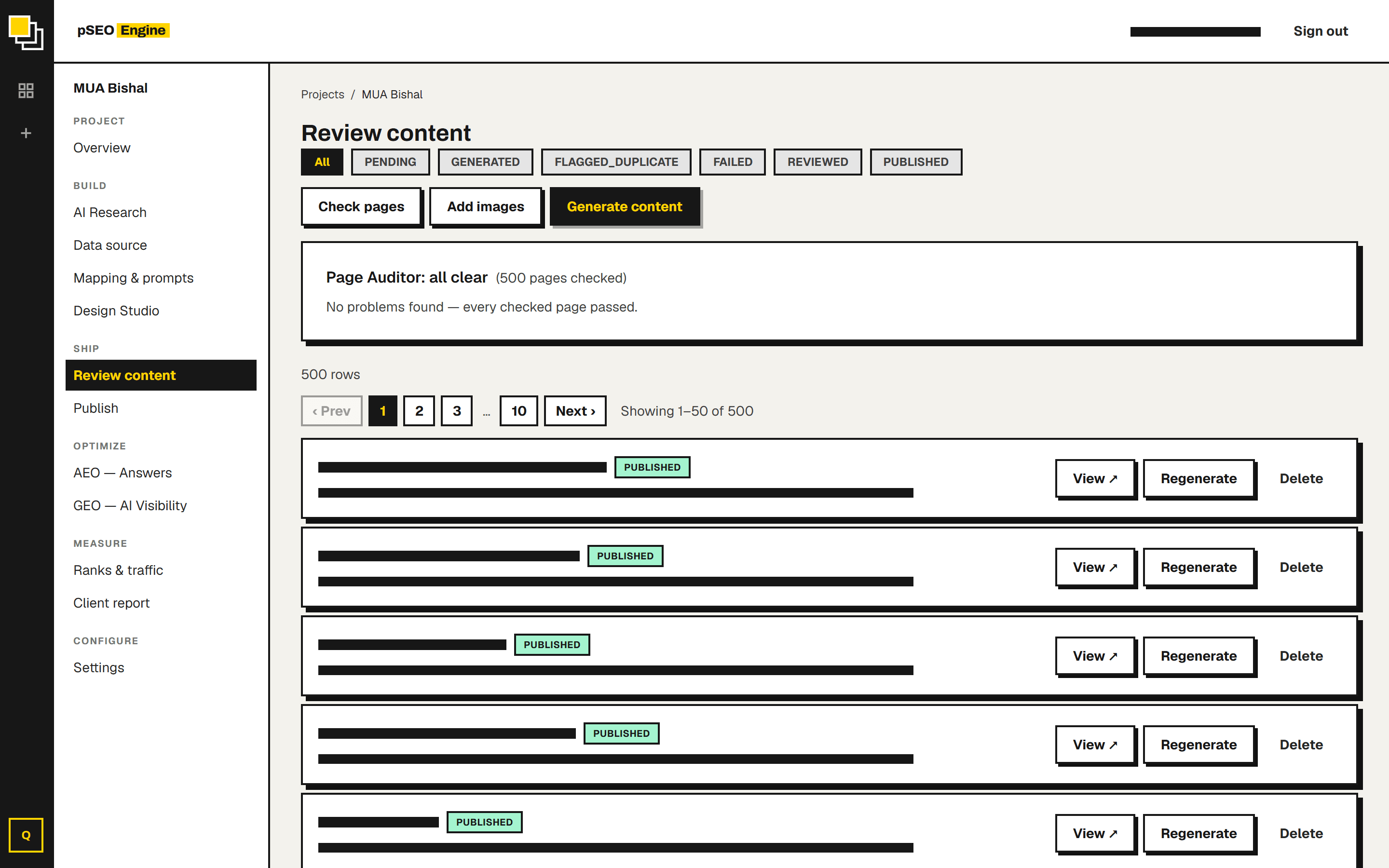
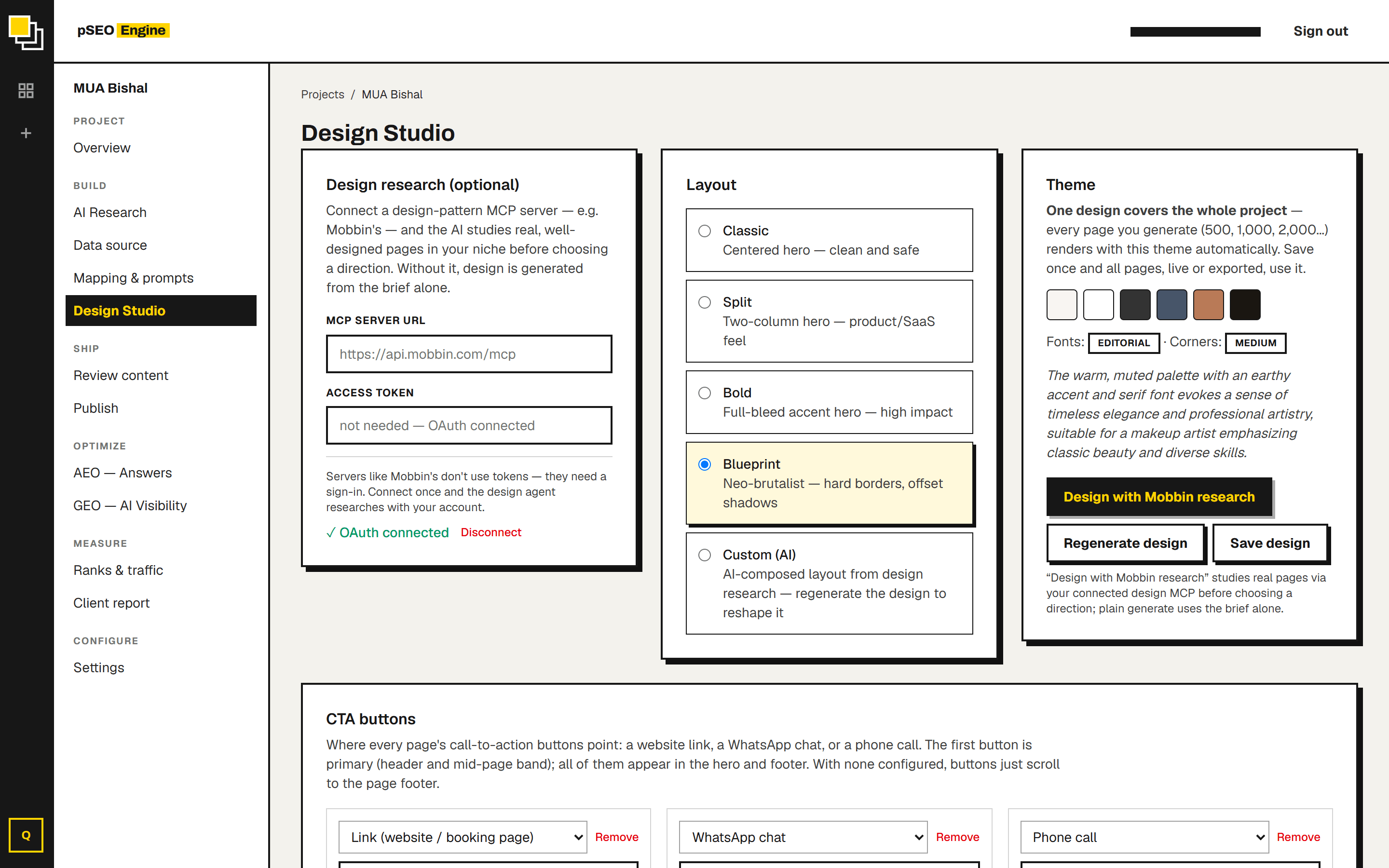
Nothing publishes until someone reads it
The review queue, with the page auditor clear across all 500. This screen is the reason the black-hat answer above is not marketing: there is no setting that generates and publishes in one action, so every page in a set passes through here.
About the black bars
The client's page paths and keywords are redacted. His signed permission covers his name, his business and a link to his site — not his keyword list, which is the competitive asset of his business.
The fair question
Is this the thing that gets sites penalised?
It can be. Programmatic SEO and doorway-page spam are the same technique pointed at different questions, and any tool that generates pages at volume can be used for either. So here is where the line is.
Doorway pages
Near-identical pages spun across a location list, all funnelling to the same place, none of them worth landing on.
What this does about it
A page is only generated for a query the research run qualified as having real intent behind it. Combinations that would produce a thin page are rejected before generation, not after — which is why the page count you end up with is usually lower than the permutation count you started with.
Scaled content abuse
Bulk-generated text published without anyone reading it, on the assumption that volume outruns quality.
What this does about it
Publishing is a separate, manual step. There is no setting that generates and publishes in one action, and that omission is deliberate — it is the feature request we decline most often.
Thin, templated substance
One page rewritten five hundred ways, where the only thing that changes is the place name in the heading.
What this does about it
The substance comes from the research row behind each page, not from a template with slots. If two pages have nothing genuinely different to say, that is a signal the market does not support two pages — and the run says so.
Ranking on a domain you do not own
Pages hosted on a vendor's subdomain, so the equity — and the leverage — sits with the vendor.
What this does about it
Pages publish to your client's own domain, with their own sitemap. If you stop paying us, the pages and their rankings stay where they are. Nothing is held hostage.
The part no tool can do for you: deciding the pages deserve to exist. The review step is where that judgement happens, and it is yours. If you publish five hundred pages you have not read, into a market that did not have five hundred questions in it, this tool will have helped you do that faster. We would rather say so here than have you find out from a manual action.
Questions worth asking before you trust this
What is a credit?
What happens when I run out of credits?
Does it publish without me looking at the pages?
Will Google penalise hundreds of generated pages?
Who owns the pages — me, or my client?
Can I run this for several clients?
What does the free trial include, and why do you ask for a card?
75 credits over 7 days. That covers one full research run (50 credits) plus about 12 generated pages — the whole workflow end to end. You can judge the research and read the writing before you pay anything.
The card is asked for up front and not charged — it is authorised for $0. The trial credits are real AI spend, and handing them to anything that can submit a form means paying for scripted signups instead of for customers. A card is the cheapest check that there is a person on the other end.
At the end of the 7 days the trial becomes the plan you picked and the card is charged, unless you cancel first — one click, from the billing page, and you are never charged. The amount and the exact date are shown to you before you enter any card details.
Who am I dealing with?
Start with 75 credits, free for 7 days.
Enough to run the research and publish your first pages before you decide anything.