Programmatic SEO for agencies
Publish 500 client landing pages without writing 500 pages.
pSEO Engine researches the queries worth building for, writes the page set, publishes it to your client's domain, and tracks where it lands.
Card required. Nothing charged for 7 days.
- /emergency-plumber-in-shoreditch
- /emergency-plumber-in-hackney
- /emergency-plumber-in-islington
- /boiler-repair-in-islington
- /boiler-repair-in-camden
- /bathroom-fitting-in-camden
- /bathroom-fitting-in-dalston
- /leak-detection-in-dalston
- /leak-detection-in-peckham
- /drain-unblocking-in-peckham
- /drain-unblocking-in-shoreditch
- /blocked-toilet-in-hackney
+ 488 more
Pages published
500
For one client, on his own domain
Credits per page
2
Costed before you start
Free credits
75
Free for 7 days
Contract length
None
Monthly or quarterly only
Three jobs, and the tool does all three
Most programmatic SEO breaks at the handoff — research in one tool, generation in another, publishing by hand. This does the whole run.
Every handoff is a place the work stops being reproducible: a spreadsheet someone edited, a template that drifted, a publish step nobody logged. Keeping the three together is less about convenience than about being able to tell a client exactly what went out, and when.
Research
It finds the queries with intent behind them
Point it at a service and a market. The research run mines the query space, qualifies what it finds against live search data, and structures the result into a page plan you can read before you commit.
- Keyword mining needs no Ahrefs or Semrush subscription
- Intent classification, so informational and commercial pages differ
- Rejects the queries that would produce a thin page
50 credits per research run, flat
- emergency plumber shoreditchBuild
- 24 hour plumber near meBuild
- plumbingDrop
- boiler repair islingtonBuild
- how does a boiler workDrop
Generate
It writes the page, you approve it
Each page is generated from your template and the row of research behind it. Nothing publishes until you have looked at it. Anyone selling you a set-and-forget version of this is selling you a penalty.
- Design studio for the page template, so the set matches the client's site
- Refresh a decaying page in place rather than rebuilding the set
2 credits per generated page
AEO and GEO
Written for the engines that answer, not only the ones that link
A growing share of searches end in an answer rather than a click. Pages are audited for whether an engine can parse, quote and credit them — and the fixes are applied where they are missing.
- AEO audit and apply, per page
- GEO visibility checks — one keyword asked of one engine, per credit
- Runs on published pages, not only at generation time
1 credit per audit · 1 per visibility check
Most emergency call-outs in Shoreditch are reached within the hour.
“Most emergency call-outs in Shoreditch are reached within the hour.”
Publish and track
It ships to your client's domain, then watches it
Pages publish to a custom domain with sitemaps generated. Live rank checks run against the set on a schedule, and a weekly report goes out to the client without you assembling it.
- Custom domains and generated sitemaps
- Live rank checks, capped per plan and included in the price
- Weekly client reports, sent automatically
- emergency plumber shoreditch#7
- boiler repair islington#12
- leak detection dalston#24
- drain unblocking peckham#38
checks run on a schedule
What a page set is
Every service, every area — minus the ones nobody searches
Multiply five services by six areas and you get thirty pages. Most tools build all thirty. This one builds the ones with a real query behind them and tells you why it dropped the rest.
That gap is the whole difference between a page set and a doorway farm, and it is why the page count you finish with is usually smaller than the permutation count you started with. Dropping a page is a result, not a failure.
The run
How a run actually goes
Five stages. The middle one is the one competitors leave out.
Research, generate, review, publish, track. Review is a gate rather than a stage — nothing downstream starts until a person has read what came out. That is the difference between a page set you can defend and one you end up apologising for.
- 01
Point it at a market
Give it a service and a set of locations, or a keyword list you already trust. Research finds the queries with real intent behind them and throws out the ones without.
- 02
Generate the page set
It writes each page from your template and the research data. 2 credits a page, so a 500-page set is a number you can work out before you start.
- 03
Read it, then publish
Review before anything goes live. Publishing is a separate step on purpose. Pages go to a domain you control, with sitemaps generated.
- 04
Watch what ranks
Live rank checks run against the published set, and weekly reports go to your client. Pages that decay can be refreshed in place.
What comes out
A generated page, pulled apart
The fair question about any tool like this is whether the output is worth publishing. Here is what one page is made of — pick a part.
Nothing publishes until you have read it. That is a separate step on purpose — anyone selling you a set-and-forget version of this is selling you a penalty.
The actual product
Not a mockup — the actual product
Everything else on this page is a diagram. These two are screenshots of the running app, taken from the client project in the case study.
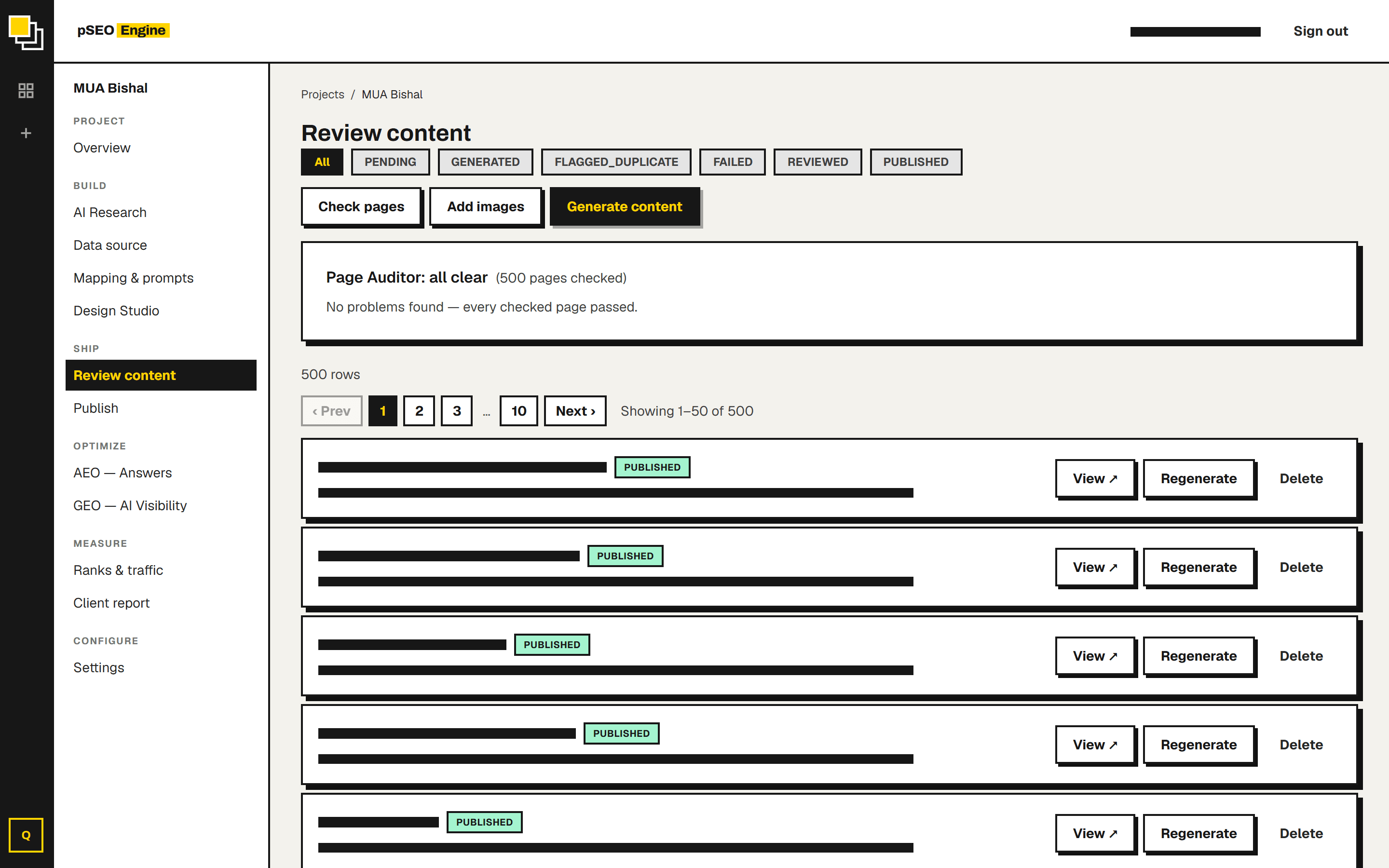
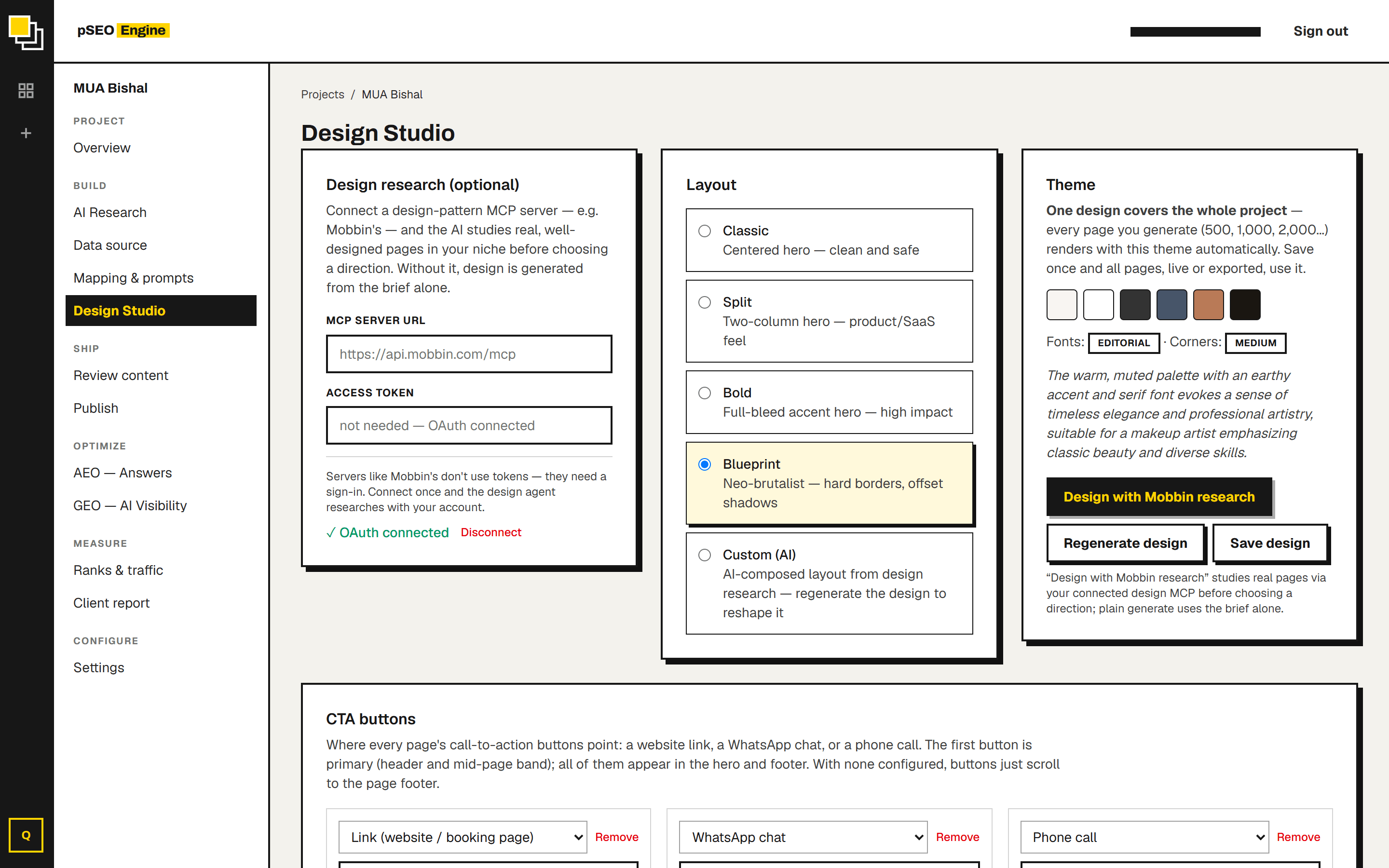
Nothing publishes until someone reads it
The review queue, with the page auditor clear across all 500. This screen is the reason the black-hat answer above is not marketing: there is no setting that generates and publishes in one action, so every page in a set passes through here.
About the black bars
The client's page paths and keywords are redacted. His signed permission covers his name, his business and a link to his site — not his keyword list, which is the competitive asset of his business.
The arithmetic
What 500 pages costs you either way
Set it to your own numbers. Nothing below is a figure we made up about your business — the four inputs are yours, and everything else is arithmetic on them.
Your assumptions — change any of them
Brief, research, draft, edit, format, publish — the whole job, not just the writing.
Your writer's rate, or your own billable rate if you would be doing it.
Not zero. Nothing publishes here until someone has read it — that step is deliberate.
By hand
- Hours of work
- 375 hrs
- Elapsed, one person
- 15.0 weeks
- Labour cost
- $11,250
At 45 minutes a page and $30 an hour, across 25 productive hours a week on this one project.
With pSEO Engine
- Hours of review
- 25 hrs
- Elapsed, one person
- 1.0 weeks
- Subscription + labour
- $1,049
1,050 credits — one research run plus 500 pages — on a $299/mo plan, plus 3 minutes a page of review at $30 an hour.
The difference
$10,201
and 350 hours back, on this one page set.
The honest version of this: it does not remove the work, it changes its shape. You stop paying for 375 hours of writing and start paying for 25 hours of reading. Whether that trade is worth it depends on the numbers you just set, which is why they are yours to set.
The fair question
Is this the thing that gets sites penalised?
It can be. Programmatic SEO and doorway-page spam are the same technique pointed at different questions, and any tool that generates pages at volume can be used for either. So here is where the line is.
Doorway pages
Near-identical pages spun across a location list, all funnelling to the same place, none of them worth landing on.
What this does about it
A page is only generated for a query the research run qualified as having real intent behind it. Combinations that would produce a thin page are rejected before generation, not after — which is why the page count you end up with is usually lower than the permutation count you started with.
Scaled content abuse
Bulk-generated text published without anyone reading it, on the assumption that volume outruns quality.
What this does about it
Publishing is a separate, manual step. There is no setting that generates and publishes in one action, and that omission is deliberate — it is the feature request we decline most often.
Thin, templated substance
One page rewritten five hundred ways, where the only thing that changes is the place name in the heading.
What this does about it
The substance comes from the research row behind each page, not from a template with slots. If two pages have nothing genuinely different to say, that is a signal the market does not support two pages — and the run says so.
Ranking on a domain you do not own
Pages hosted on a vendor's subdomain, so the equity — and the leverage — sits with the vendor.
What this does about it
Pages publish to your client's own domain, with their own sitemap. If you stop paying us, the pages and their rankings stay where they are. Nothing is held hostage.
The part no tool can do for you: deciding the pages deserve to exist. The review step is where that judgement happens, and it is yours. If you publish five hundred pages you have not read, into a market that did not have five hundred questions in it, this tool will have helped you do that faster. We would rather say so here than have you find out from a manual action.
What it costs
Work out your number before you sign up
Research costs 50 credits a run and each page costs 2. That means “250 credits” buys very different things depending on how you work — so here is the arithmetic, not a promise.
2 credits each. A city-by-service set for one client is usually 200–600.
50 credits each, flat. One run covers one market — most agencies run one per new client.
- 500 pages × 2
- 1,000
- 1 research × 50
- 50
- Credits a month
- 1,050
The plan that covers it
Scale$299/mo
Scale includes 3,000 credits, 10 projects and 3,000 rank checks a month.
Credits used
35%
Credits left over
1,950
Cost per page
$0.60
1,050 of 3,000 credits
Quarterly billing is cheaper on every tier. Prices shown are what you are charged — nothing here is a starting-from figure.
Pricing
Credits are included in every plan. Generating a page costs 2, so you can work out what a campaign costs before you run it.
Keyword mining runs on free autocomplete and competitor sitemaps, so there is no Ahrefs or Semrush subscription to buy on top. Live SERP positions and search-volume enrichment use your own Serper key — their free tier covers 2,500 checks. Plans are monthly or quarterly only, with no annual contract, and top-up credits do not expire if a campaign overruns.
Starter
$49/month
or $129 quarterly — saves $18
- 250 AI credits a month
- About 125 generated pages, at 2 credits each
- 1 client project
- 250 live rank checks a month
- AI research, design studio, AEO and GEO optimization
- Custom domains, sitemaps, weekly client reports
Growth
$129/month
or $349 quarterly — saves $38
- 1,000 AI credits a month
- About 500 generated pages, at 2 credits each
- 3 client projects
- 1,000 live rank checks a month
- AI research, design studio, AEO and GEO optimization
- Custom domains, sitemaps, weekly client reports
Scale
$299/month
or $799 quarterly — saves $98
- 3,000 AI credits a month
- About 1,500 generated pages, at 2 credits each
- 10 client projects
- 3,000 live rank checks a month
- AI research, design studio, AEO and GEO optimization
- Custom domains, sitemaps, weekly client reports
Out mid-campaign? 100 credits for $19, 500 credits for $79. Top-up packs never expire. Plans are monthly or quarterly only — there is no annual contract, and you can cancel whenever.
For AI agents
Your agents can buy their own credits.
The same engine, reached over MCP instead of a browser. An agent key holds a prepaid balance and every tool call debits it — research, generation, audits, publishing. No plan, no card to sign up, and nothing expires — you pay once, when you buy a pack. Read tools are free and so is creating a project, so a whole integration can be wired up and tested before anything is paid.
Agent Pilot
$499one-off
$499 of balance
- About 665 generated pages, or 66 research runs.
- Never expires, no subscription
- No card to sign up
- Per-key daily spend cap
- Every call itemised on the key's ledger
Agent Scale
$1,499one-off
$1,649 of balance — $150 more than you pay
- About 2,198 generated pages. 10% bonus balance.
- Never expires, no subscription
- No card to sign up
- Per-key daily spend cap
- Every call itemised on the key's ledger
Agent Fleet
$3,999one-off
$4,799 of balance — $800 more than you pay
- About 6,398 generated pages. 20% bonus balance.
- Never expires, no subscription
- No card to sign up
- Per-key daily spend cap
- Every call itemised on the key's ledger
Buying for a team of people rather than a fleet of agents? The monthly plans above are the human product.
Questions people ask first
What is a credit?
What happens when I run out of credits?
Does it publish without me looking at the pages?
Will Google penalise hundreds of generated pages?
What does the free trial include, and do you need a card?
75 credits over 7 days, and no card. Confirm your email address and the credits are on your account.
That covers one full research run (50 credits) plus about 12 generated pages — the whole workflow end to end. You judge the research and read the writing before you pay anything, because there is nothing to pay until you choose a plan.
Nothing renews on its own. When the credits run out generation stops, published pages stay live, and rank tracking keeps running — you pick a plan if and when the trial has earned it.
Start with 75 credits, free for 7 days.
Enough to run the research and publish your first pages before you decide anything.